Sep
How To Grow Marijuana Seeds
Paper Towel Germination: Extension Steps and Why Seed Quality Matters
Yes, you can reliably germinate most garden, flower, and cannabis seeds on a damp paper towel. Done right, moisture stays even, warmth stays steady, and you check daily. Sanitation matters as much as moisture control. Transplant the moment you see a radicle, then follow whatever timing your seed packet specifies.
TL;DR:
- Most seeds germinate reliably in 2 to 10 days on a damp paper towel, with temperature and seed age significantly affecting the timing.
- Proper sanitation, including using fresh materials and clean hands, is crucial to prevent mold and contamination during germination.
- Handle sprouted seeds carefully with tweezers or toothpicks, planting the root end at the recommended depth into moist, well-aerated soil.
- Testing seed viability with a paper towel is effective for older or questionable seeds before planting large batches.
- Fast germination strains like Star Killer autoflower and Biscotti feminized seeds have high success rates when purchased from reputable sources with a germination guarantee.
Table of Contents
- What is paper towel germination and does it actually work?
- What supplies do you need for paper towel seed sprouting?
- How do you germinate seeds using the paper towel method?
- How long does paper towel germination take?
- Why aren’t my seeds germinating in a paper towel?
- How do you transplant sprouted seeds without killing them?
- Why seed quality still determines your success rate
- Paper towel or direct sowing: which should you choose?
- Where to buy seeds that actually germinate
- Sources
- FAQ
What is paper towel germination and does it actually work?
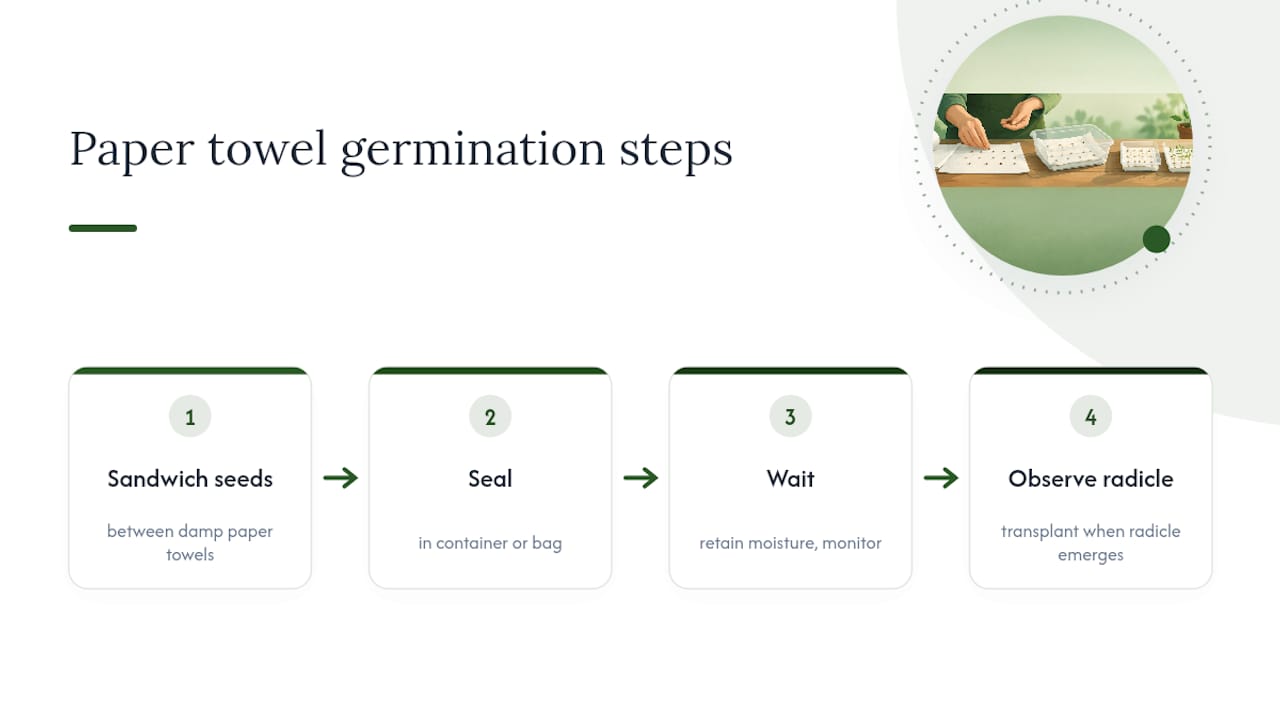
Paper towel germination is a viability test that also doubles as a head start on planting. You sandwich seeds between two damp paper towels, seal them in a container or bag, and wait for the root (radicle) to emerge before moving the seed into soil. University extension programs use a near-identical version of this technique to test commercial seed lots for viability, and UAF’s Cooperative Extension Service publishes a stepwise procedure that home growers can copy almost exactly.
The method isn’t magic. It speeds up monitoring because you can see the radicle the moment it pushes through the seed coat, something the soil hides from you for days. But it doesn’t override what the seed itself needs. A dormant seed stays dormant on a paper towel just as it would in soil, and a seed that’s past its viable shelf life won’t sprout no matter how carefully you baby it. Think of the paper towel as a window into the germination process, not a shortcut around biology.
Gardeners reach for this method most often when starting seeds indoors ahead of the outdoor planting window, testing old seed packets before committing a whole tray to them, or working with seeds like cannabis where confirming a taproot before planting saves growing space and reduces wasted soil. Gardening Know How notes it works well across many vegetables, herbs, and flowers, though a few crops respond better to direct sowing, something worth knowing before you commit an entire seed packet to towels.
What supplies do you need for paper towel seed sprouting?
You don’t need anything specialized. Most of what you need is already in your kitchen or a nearby dollar store.
- Plain, uncoated white paper towels or unbleached coffee filters (avoid scented or lotion-infused towels)
- A resealable plastic bag or a shallow container with a lid to hold humidity
- A spray mister or spray bottle for even moistening
- Labels or a permanent marker for dating and identifying seed batches
- Tweezers or a wooden toothpick for handling germinated seeds without crushing them
Sanitation is where a lot of home growers cut corners, and it’s usually the reason mould shows up on day four. Wash your hands before handling seeds, since oils and bacteria on skin can introduce contamination to a damp, enclosed environment. If you’re reusing plastic containers from previous batches, a quick rinse in a diluted bleach solution (roughly one part bleach to nine parts water), followed by a thorough rinse with clean water, cuts down on carryover pathogens, a tip echoed in University of Nebraska’s seed-starting guidance. Fresh, unused paper towels for every batch matter more than people assume. Reused towels often carry residual mould spores you can’t see.
If you’re testing viability rather than just starting seeds to plant, pull a random sample instead of testing only the biggest or healthiest-looking seeds. A batch of 10 seeds gives you a rough read; 20 to 25 gives you a more dependable percentage, since a small sample can swing wildly on a single non-sprouting seed. This matters most if you’re deciding whether an older seed packet is worth planting a full tray of, or just a few.
Pro Tip: Label each bag with the seed variety and the date you started the test, not just the variety. When you’re running three or four batches at once, “day 3” and “day 7” look identical if you don’t write it down.
How do you germinate seeds using the paper towel method?
Here’s the exact sequence, adapted from extension procedures and refined for a kitchen counter setup:
- Moisten the towels evenly. Wet two paper towels under the tap, then wring them out until they’re damp but not dripping. A towel that’s actively releasing water when you squeeze it is too wet and will drown the seeds of oxygen.
- Lay the seeds in spaced rows. Place seeds on one towel, leaving at least an inch between each one. Crowding seeds together makes it easy for mould on one seed to spread to its neighbours.
- Cover with the second damp towel. Press gently so the seeds have full contact with damp paper on both sides, which is what triggers the water uptake, or imbibition, that kicks off germination.
- Seal the sandwich in a labelled container or bag. A sealed environment traps humidity so you’re not remoistening constantly. Leave the bag loosely closed if you’re worried about airflow, since a fully airtight seal with heavily saturated towels can suffocate seeds.
- Store at a stable, crop-appropriate temperature. Most vegetable and flower seeds do well in the 65 to 75°F range. Warmth-loving seeds like tomatoes and peppers germinate faster closer to 80°F.
- Check every 24 to 48 hours. Open the bag, inspect for dryness or mould, and mist lightly if the towel has started to dry out at the edges.
- Remove any mouldy or rotting seeds immediately. Leaving one bad seed in the batch risks spreading fungal spores to healthy seeds nearby.
- Transfer sprouted seeds as soon as the radicle appears. Don’t wait for a long root. A radicle of a quarter inch to half an inch is plenty.
The transfer step is where most beginners damage their seedlings, so it’s worth slowing down here. Stabilize the towel with one hand so it doesn’t shift. Use tweezers or a toothpick to lift the seed by the seed coat itself, never by the fragile white root. Squeezing or tugging on the radicle at this stage can snap it or bruise the tissue, and a damaged radicle often means a seedling that never fully establishes.
Plant the sprouted seed into a moist, sterile seed-starting mix, root end down, at the depth recommended on the seed packet. Firm the soil gently around it, just enough to hold the seed in place without compacting the mix. If the radicle has grown long enough to curl, plant it in the direction it’s already curling rather than forcing it straight. Cannabis growers in particular tend to rush this step because the taproot on those seeds grows fast; Theseedpharm’s germination guide covers the cannabis-specific timing and handling differences in more depth.
Pro Tip: Once you notice a radicle, check the batch every 12 hours instead of every 24 to 48. Roots that sit too long in the towel can start growing into the paper fibres, and pulling them free at that point tears delicate root hairs.
How long does paper towel germination take?
There’s no single answer, and any source that gives you one number for all seeds is oversimplifying. The most reliable baseline is the “days to germination” printed right on your seed packet. Paper towels help you watch the process closely, but they don’t change how fast a seed’s internal biology runs.
That said, general patterns hold across most common garden seeds:
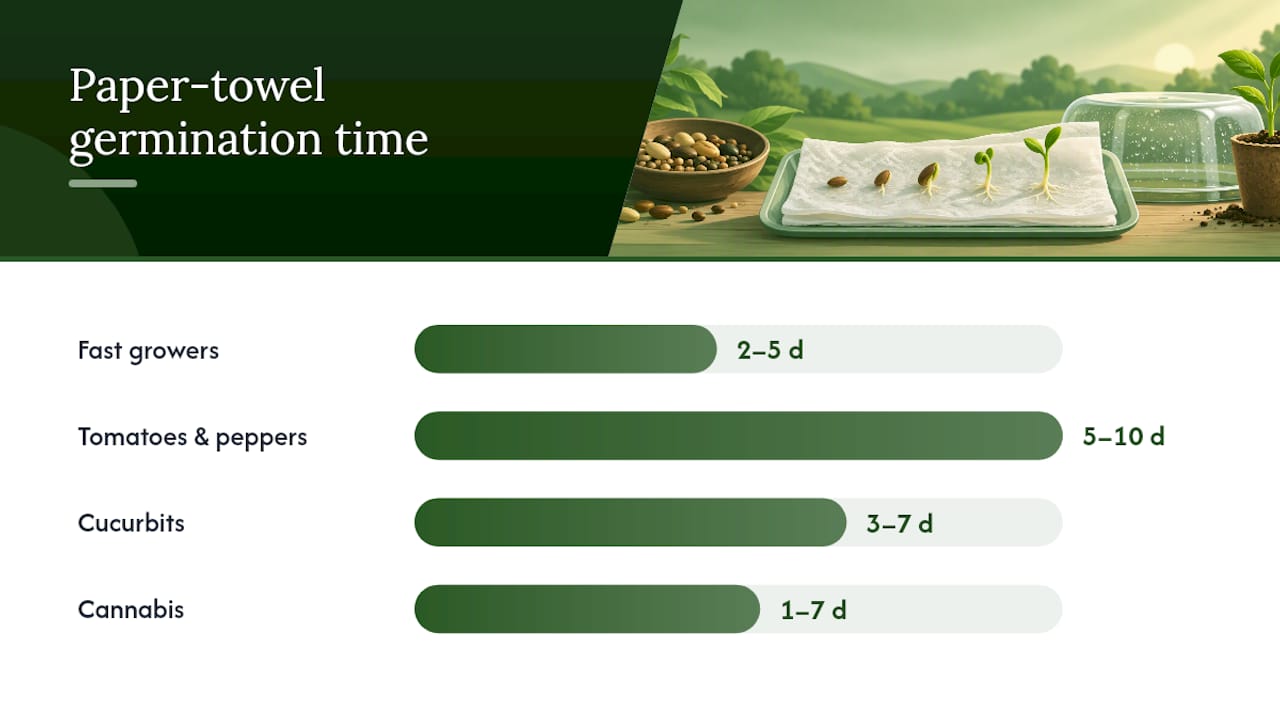
- Lettuce, radish, and other fast growers: 2 to 5 days under warm, stable conditions
- Tomatoes and peppers: 5 to 10 days, faster with bottom heat closer to 80°F
- Cucumbers and squash: 3 to 7 days
- Cannabis: commonly 1 to 7 days, though genetics and seed age shift this window
- Slow or dormant species (some tree seeds, certain perennials): weeks to months, often requiring cold stratification first
Temperature drives most of the variation you’ll see. Virginia Cooperative Extension identifies temperature, seed age, dormancy, moisture, and oxygen availability as the core variables controlling germination speed, and recommends 65 to 75°F as a solid general range for many species. Drop below that range and metabolic processes slow down; seeds that would sprout in four days at 72°F might take twice as long sitting on a cool windowsill at 58°F. A seedling heat mat under your container solves this cheaply if your house runs cold.
Seed age complicates the picture further. Older seeds lose vigour over time, and some species carry built-in dormancy mechanisms that block germination until specific conditions are met. Certain legumes and many tree seeds have hard seed coats that need scarification (nicking or lightly sanding the coat) before water can even get in. Others need a period of cold, moist stratification to mimic winter before they’ll sprout at all. If you’re working with seeds that have been in storage for a year or more, Theseedpharm’s guide on seed storage explains how age and storage conditions affect viability, and dormancy-prone varieties are covered in more detail in their dormant seeds guide.
Keep a simple log for each batch: seed variety, start date, temperature, and the day you first saw a radicle. Over a few grow seasons this record tells you far more about your own conditions than any generic chart ever will.
Why aren’t my seeds germinating in a paper towel?
Work through this in order rather than jumping straight to “my seeds are bad,” since the most common causes are fixable and have nothing to do with seed quality.
- Check viability first. Run a fresh test with a new, larger sample. If none of 20 seeds sprout, the batch itself is likely the problem, not your technique.
- Check moisture levels. Squeeze the towel gently; if water runs out, you’ve oversaturated it and starved the seeds of oxygen. If the towel feels dry to the touch, seeds have stalled from lack of water.
- Check temperature. A cold room (below 60°F) slows or halts germination for most warm-season crops. Move the container somewhere warmer, or add gentle bottom heat.
- Check for dormancy. If the species needs scarification or stratification and you skipped it, no amount of moisture or warmth will help.
- Check ventilation. A fully sealed bag with saturated towels traps stale air. Crack the seal slightly to let a small amount of fresh air exchange happen.
Mould is the other major failure mode, and it usually shows up as fuzzy white, grey, or black growth on the seed or towel by day three or four. Mississippi State Extension’s disease guidance points to cool, wet conditions and poor air circulation as the two biggest drivers of fungal problems in germination setups, more so than any single “bad” batch of seeds. The moment you spot mould, remove the affected seed with tweezers rather than leaving it to spread spores to its neighbours. Swap in fresh, dry towels for the rest of the batch, and increase airflow by leaving the container lid slightly ajar.
Pro Tip: If more than half a batch molds within 48 hours, the problem is almost always the environment, not the seeds. Cut ventilation issues and excess moisture before you assume the seed lot is bad.
Interpreting a low germination rate takes some judgment. A commercial seed lot with a stated germination rate on the packet gives you a benchmark. If your paper towel test comes in noticeably lower, retest with a fresh sample before writing off the whole batch. Extension protocols count a seed as viable once it shows a strong root and an emerging shoot, so don’t count a barely-cracked seed coat as a success; wait for an actual visible radicle before you tally results. Small sample sizes swing hard on a single seed, so a 3 out of 5 result means far less than a 15 out of 20.
How do you transplant sprouted seeds without killing them?
Timing is everything here. Move the seed the moment the radicle is visible, ideally before it’s grown long enough to embed itself into the towel fibres. Wait too long and pulling the seed free tears root hairs that took days to grow.
- Prepare your container before you check the towel. Fill small pots or trays with a sterile, well-aerated seed-starting mix, and pre-moisten it so the seed isn’t dropped into dry soil.
- Handle by the seed coat, never the root. Use tweezers or a toothpick to lift the seed, gripping the hard outer shell rather than the tender white radicle.
- Plant root-side down at the correct depth. Follow the depth guidance on your seed packet. As a rough rule, plant at a depth roughly twice the seed’s diameter.
- Water gently right after planting. A light misting settles the soil around the seed without displacing it or exposing the root to air.
- Cover loosely to hold humidity for the first few days. A humidity dome or a clear plastic bag over the tray helps the seedling adjust from the enclosed paper towel environment to open air.
Once the seedling emerges above the soil, start reducing humidity gradually rather than pulling the cover off all at once. A sudden shift from a sealed, humid bag to dry open air can shock a young seedling. Vent the cover for an hour a day, then extend it over the following days. Keep the growing medium consistently moist but never soggy. This is the same moisture balance that governed your paper towel setup, and it’s still the number one thing that separates a healthy seedling from one that develops damping-off. Good drainage in the container and clean tools throughout the process cut disease risk far more than any product you could add to the soil.
Why seed quality still determines your success rate
No paper towel technique fixes a bad seed. Theseedpharm inspects each seed batch before it ships and backs orders with a 90% germination guarantee, which matters more than most growers realize until they’ve fought through a batch of unhealthy, old, or mishandled seed. A fresh, well-stored seed with strong genetics gives you a fast, clean radicle with none of the stalling or mould issues that plague poor-quality stock.
Seed banks carry a variety of strains across feminized, autoflowering, regular, and CBD categories, giving growers room to pick genetics suited to their specific setup rather than settling for whatever’s available. Orders often ship discreetly with tracking, and some vendors include free seeds with larger orders. For cannabis-specific germination notes, from taproot handling to transplant timing, the germination guide and the safe handling guide cover details that generic paper towel tutorials skip entirely.
Paper towel or direct sowing: which should you choose?
Paper towels earn their keep when you’re testing viability on an older seed packet, working with seeds you plan to transplant anyway, or want visual confirmation of a taproot before committing pot space, cannabis growers fall into this last group constantly. Direct sowing wins for very small seeds like carrots or poppies, and for crops that resent root disturbance, since transplant shock can undo any head start the towel gave you.
My rule of thumb: if the seed is expensive, old, or you’re anxious about viability, test it on a towel first. If it’s cheap, tiny, or the plant hates being moved, skip the towel and put it straight in soil. Overthinking this choice wastes more seed than either method does on its own.
— The
Where to buy seeds that actually germinate
Technique only gets you so far if the seed itself was weak to begin with. That’s the gap Theseedpharm closes: every batch goes through an inspection process before listing, and orders carry a 90% germination guarantee, so a failed paper towel test is far less likely to come down to the seed you started with.
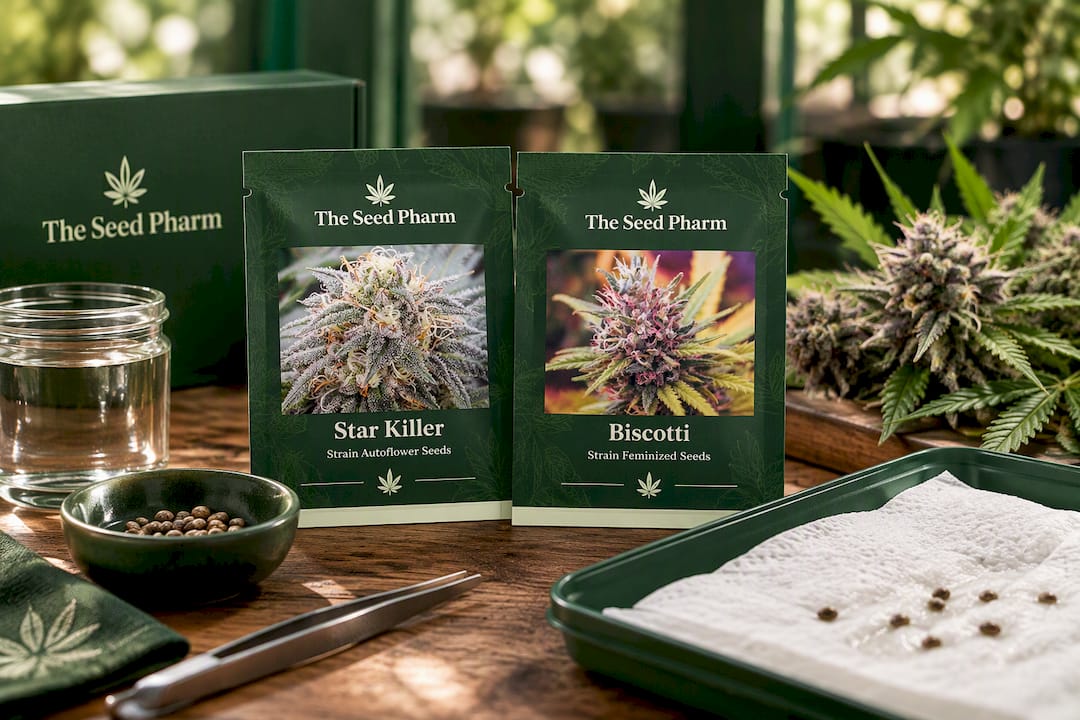
Right now, the 4 Free Seeds 420 Magazine Deal adds bonus genetics to qualifying orders, a straightforward way to test the paper towel method across a few strains without extra cost. If you want a fast, forgiving strain to start with, Star Killer autoflower seeds germinate reliably and move quickly from seedling to harvest without needing a light-schedule change. For growers after stable, well-documented feminized genetics, Biscotti feminized seeds are a solid pick for a first paper towel batch. Browse the full catalogue of feminized, autoflower, and CBD seeds to find genetics suited to your climate and grow setup, then order and put this guide to work on your own kitchen counter.
Sources
- Procedures for the Wet Paper Towel Germination Test | Cooperative Extension Service
- Plant propagation and germination guidance | Virginia Cooperative Extension
- Damping-off and disease prevention | Mississippi State Extension
- Germinating seeds in paper towel | Gardening Know How
FAQ
How long should you germinate seeds in a paper towel?
Most vegetable and flower seeds sprout within 2 to 10 days on a damp paper towel, with fast growers like lettuce and radish often showing a radicle in 2 to 5 days. Always cross-check against your seed packet’s stated germination window, since temperature and seed age shift the timeline considerably. If nothing sprouts after roughly double the packet’s stated window, treat the batch as low viability and retest.
Can I use a paper towel for a seed germination test?
Yes, a paper towel test is a standard method extension services use to check seed viability before planting a full tray. Select a random sample of 10 to 25 seeds, follow the wet towel procedure, and calculate your germination percentage as viable seedlings divided by total seeds tested.
What seeds germinate best in a paper towel?
Most vegetables, herbs, flowers, and cannabis seeds do well with this method, since it lets you confirm a taproot before transplanting. Very small or direct-sow crops like carrots and radishes often do better sown straight into soil, since their fine roots are easily damaged during transfer. Fresh, quality seed from a reputable source like Theseedpharm also germinates more consistently than older or poorly stored stock.
Why are my seeds not germinating when I use paper towels?
The most common causes, in order of likelihood, are incorrect moisture (too wet or too dry), temperature outside the 65 to 75°F range for most species, and undiagnosed dormancy that requires scarification or stratification. Mould from poor ventilation is another frequent culprit, and cool, wet, poorly aerated conditions are the biggest driver of that problem. Run a fresh test with a larger sample before concluding the seed batch itself is bad.
When should I transplant sprouted seeds from a paper towel?
Move the seed into soil as soon as the radicle is visible, ideally when it’s still short enough that it hasn’t grown into the towel fibres. Waiting too long risks tearing the root during removal, which can stunt or kill the seedling before it establishes.
Recommended