
Oct
How To Grow Marijuana Seeds
Home Growers, Flush Cannabis Before Harvest: Evidence Based Timelines
Start flushing when about 50% of trichomes turn milky with 10 to 30% amber, then run plain, pH-adjusted water through the medium for a set window: roughly 7 to 14 days in soil, 5 to 7 days in coco, and 3 to 5 days in hydroponic setups. Track runoff or reservoir EC as it trends toward your baseline water, and harvest early if fan leaves yellow too fast.
TL;DR:
- Flushing should start when about 50% of trichomes are milky with 10-30% amber, checked under magnification directly on buds every one to two days.
- Flush duration varies by medium: 7-14 days in soil, 5-7 days in coco, and 3-5 days in hydroponic systems, adjusting for high or low feeding levels.
- Rely on runoff or reservoir EC trending toward baseline water EC rather than fixed calendar days to time the flush effectively.
- Longer or earlier flushes than medium-specific windows risk yellowing and weight loss, especially in soil, without guaranteed quality improvements.
- Post-flush, handle plants gently, give a short dark period if desired, and focus on proper drying and curing to maximize smoke quality.
Table of Contents
- What flushing is and why growers use it
- When to start flushing: trichome timing and inspection technique
- Flush duration and method by growing medium
- Step-by-step flush procedure and monitoring
- What science says about flushing: yield, cannabinoids, and tissue nutrients
- Risks, common mistakes and troubleshooting during a flush
- Impact of flushing on nutrient uptake and plant physiology
- Differences in flushing techniques for various cannabis strains
- Post-flush care and handling before harvest
- Environmental factors affecting flushing efficacy
- Author’s perspective: a conservative, low-risk flushing protocol
- Seeds and resources for predictable flowering windows
- FAQ
- Sources
What flushing is and why growers use it
Flushing means running plain water, sometimes pH-adjusted, through the growing medium in the final one to two weeks before harvest, cutting off the usual nutrient solution. The idea is to strip excess mineral salts from the root zone and push the plant to draw on whatever nutrients it has already stored in its tissue.
Growers who flush generally aim for a few outcomes:
- Smoother smoke with less harshness from unused mineral salts.
- Clearer terpene expression, since some growers believe leftover nutrients mute aroma and flavour.
- Lighter ash colour, often used as an informal sign of a clean burn.
None of these outcomes are guaranteed, and the degree to which flushing delivers them depends heavily on how the plant was fed before the flush even started. A crop pushed hard with high-EC nutrient solutions has more to clear than one grown on a lighter feeding schedule, and that difference matters more than the calendar date.
This is also why timing a flush by trichome colour and runoff EC tends to work better than picking a flush date in advance. Two plants of the same strain, started on the same day, can finish at different rates depending on light intensity, temperature, and genetics. A fixed “flush on day 60” rule ignores all of that, while checking trichomes and runoff lets you react to what the plant is actually doing.
When to start flushing: trichome timing and inspection technique
The most reliable signal for starting a flush is trichome colour, not the calendar. Hydrobuilder’s grower guidance points to starting a flush once roughly half the trichomes on the buds have turned milky white, with another 10 to 30% shifting to amber. That mix suggests the plant is approaching peak cannabinoid development without having already passed it.
Checking trichomes properly takes a bit of care:
- Use a jeweller’s loupe or a small USB microscope, not the naked eye; trichome colour is hard to judge without 30x to 60x magnification.
- Inspect trichomes directly on the buds themselves, not on fan leaves or even sugar leaves, since those can mature at a different pace.
- Check several buds from different parts of the canopy, since lower buds often lag behind top colas.
- Repeat the check every one to two days as harvest approaches, since trichome colour shifts quickly in the final stretch.
Cultivar matters here too. Some strains hold a cloudy, milky look for a long stretch before amber develops, while others swing to amber quickly once they start. That variation is part of why a single fixed day count rarely fits every plant.
Pro Tip: Photograph the same bud site every time you check trichomes, so you are comparing against a known reference point rather than relying on memory.
Once trichomes hit your target ratio, you can schedule the flush length for your medium and start counting down to harvest from there, adjusting if buds yellow faster than expected.
Flush duration and method by growing medium
How long a flush needs to run depends heavily on what you are growing in, since different media hold and release nutrients at different rates.
- Soil. Plan for 7 to 14 dayswith organic, heavily amended soils often needing the full two weeks since nutrients are bound into organic matter and release slowly. Lighter, synthetic-fed mixes tend to clear faster, closer to the shorter end of that range.
- Coco coir. Plan for 5 to 7 days. Coco holds onto calcium and magnesium through cation exchange, so even after a flush some Ca/Mg can remain bound to the medium; factor that in rather than expecting runoff EC to hit zero.
- Hydroponics and recirculating systems. Plan for 3 to 5 daysdraining and refilling the reservoir with plain, pH-adjusted water and watching reservoir EC drop toward a near-baseline target rather than waiting for a long soak-and-leach cycle like soil requires.
Across all three media, a heavy feeding history extends the clock. A crop run at high EC late into flower has more dissolved salt built up in the root zone and surrounding medium, so it takes longer for runoff or reservoir readings to approach your source water’s baseline. If you fed conservatively throughout flower, you can often lean toward the shorter end of each range without sacrificing much.
The reverse also holds: pushing a flush well past these windows, especially in soil, is one of the more common ways growers trigger premature yellowing and lose finished weight for no real gain in quality.
Step-by-step flush procedure and monitoring
Before starting, gather an EC meter, a pH meter, a jeweller’s loupe, a measuring cup, and trays to catch runoff. These let you track what is actually happening in the root zone instead of guessing by the calendar.
Start by measuring your water source’s baseline EC before adding anything to it, then adjust pH to whatever range you have been running throughout flower. Write that baseline number down, since it is the target your runoff or reservoir readings are working toward.
From there, the procedure differs slightly by setup:
- In soil or coco, leach plain, pH-adjusted water through the medium until you collect runoff, then test that runoff’s EC and compare it against your baseline.
- Repeat waterings over the flush window, watching runoff EC trend downward each time; a flattening or rising reading suggests the medium is still releasing stored salts.
- In hydroponic or recirculating systems, drain the reservoir fully and refill with fresh, pH-adjusted water, aiming for reservoir EC in the 0.2 to 0.5 mS/cm range by the end of the flush window.
Runoff EC trending toward your source water’s baseline is the clearest sign a flush is workingand commercial growers often log EC daily during the final stretch before harvest to catch problems early.
Purpose-built flushing or clearing agents exist for growers running larger, high-input operations where irrigation lines and media need consistent cleaning between cycles. These products are chelating or oxidizing formulas designed to loosen bound salts faster than plain water alone. They tend to matter most in commercial-scale setups with heavy feeding histories rather than small hobby grows on a light feeding schedule, and manufacturer dosing should be followed exactly, ideally tested on one plant before applying it across a room.
What science says about flushing: yield, cannabinoids, and tissue nutrients
Academic research on flushing tells a more complicated story than grower forums usually suggest. A university study on cannabis nutrient management found that preharvest flushing reduced nitrogen concentration in leaf tissue fairly quickly, but flower tissue nitrogen often stayed largely unchanged. That gap between leaf and flower response may explain why flushing’s effect on smoke quality is so anecdotal and inconsistent from one report to the next.
A few other findings are worth weighing before committing to an aggressive flush:
- Flushing sometimes reduced overall yield in controlled studies without any corresponding rise in cannabinoid totals.
- A Clemson dissertation on controlled-environment cannabis production found flushing’s effects on dry mass and nutrient partitioning varied by cultivar, with no single outcome holding across all genetics tested.
- Recent HortScience research found fertilizer restriction and flushing can reduce plant area and reproductive mass, though some regimes improved inflorescence-to-trim ratios depending on environmental conditions.
Put together, these results suggest flushing may shift smoke taste and feel even when total cannabinoid content barely moves, since the mechanism likely has more to do with clearing mineral salts and residual compounds than with cannabinoid synthesis itself. Cultivar, flush length, and how hard the plant was fed beforehand all shape how much benefit, if any, shows up in the final product.
Risks, common mistakes and troubleshooting during a flush
A flush that runs too long or starts too early tends to cost more than it gives back.
- Starting the flush before trichomes reach the 50% milky mark, which can harvest the plant before cannabinoid development peaks.
- Running the flush well past the medium-specific window, particularly in soil, which risks stripped nitrogen reserves and reduced finished weight.
- Ignoring runoff or reservoir EC readings entirely and relying only on a fixed day count.
- Mistaking normal late-flower yellowing for a sign the flush “worked” when it is actually a sign of nitrogen deficiency progressing too fast.
If runoff EC refuses to drop after several waterings, check your water source EC again. It may have risen, or the medium may be holding more bound salt than expected, which is common in coco due to its calcium and magnesium buffering.
If fan leaves start yellowing rapidly and buds have not yet hit your trichome target, that is a sign of more severe nitrogen loss than intended. Our guide to cannabis leaves turning yellow and the related piece on causes and solutions for yellow cannabis leaves both cover how to distinguish normal late-flower fading from a deficiency moving faster than planned.
Pro Tip: If yellowing spreads into upper fan leaves and buds are already at your trichome target, prioritize harvesting over trying to rescue the plant with a quick refeed.
A short, low-dose refeed can sometimes slow severe yellowing if trichomes are not yet ready, but if they are close to target, harvesting early is usually the safer call than risking further tissue loss.
Impact of flushing on nutrient uptake and plant physiology
Cutting off nutrient solution does not immediately starve the plant since cannabis stores a reserve of nitrogen, phosphorus, and potassium in its leaf tissue during flower. When you flush, roots stop taking up new mineral salts from the medium, and the plant begins drawing down those stored reserves instead, typically pulling nitrogen from older fan leaves first.
That remobilization is what produces the yellowing pattern growers associate with a “successful” flush, lower leaves fading while upper growth holds colour longer. The USU nutrient management research found this pattern shows up clearly in leaf tissue nitrogen levels, which drop measurably during a flush, while flower tissue nitrogen often stays more stable through the same window.
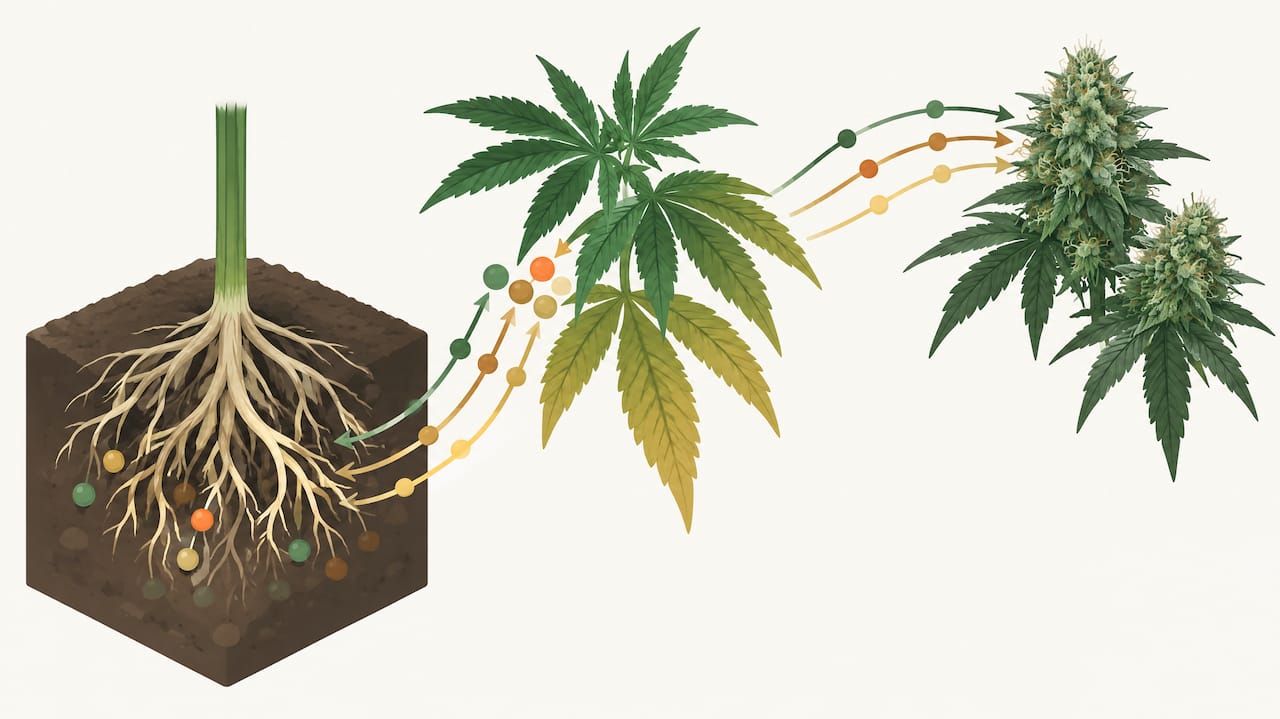
That distinction matters physiologically. Flower tissue appears to hold onto its nutrient content more tightly than leaves do, at least over typical flush durations of one to two weeks. Root uptake slows as salt concentration in the surrounding medium drops, which is the entire point of a flush, but the plant’s internal nutrient transport systems keep moving stored reserves toward flowers and newer growth regardless. Our piece on nutrient deficits covers how these shortages present across different nutrients, useful context for telling a normal flush response apart from a deficiency that started too early or ran too long.
Differences in flushing techniques for various cannabis strains
Not every cultivar reaches trichome maturity on the same schedule, and flushing protocols need to flex around that rather than forcing every plant onto an identical countdown. Fast-finishing autoflowering strains often move through the milky-to-amber trichome transition more quickly than long-flowering photoperiod varieties, which means a flush window planned too far in advance can miss the trichome target entirely.
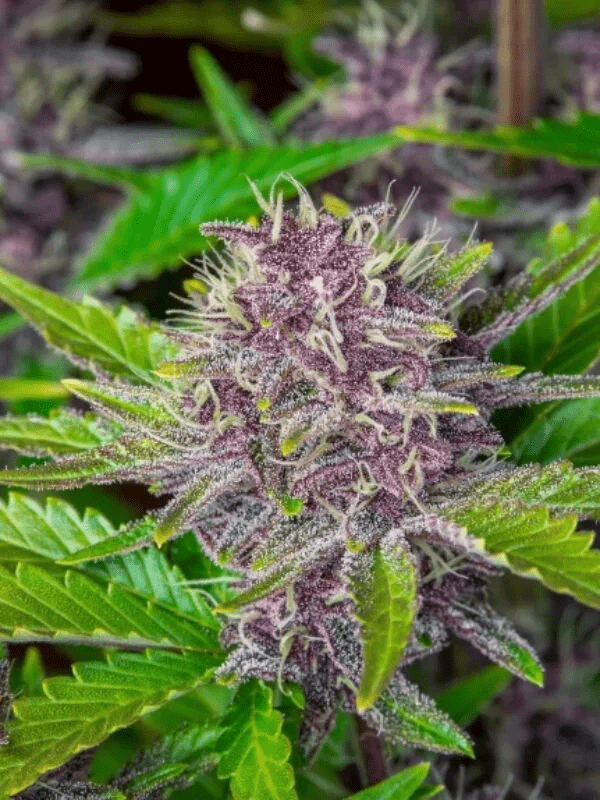
Strains with dense, resin-heavy buds, similar to Purple Punch Strain Autoflower Seedssometimes hold moisture and nutrient reserves longer into the flush window than looser, airier bud structures, which can mean leaning toward the longer end of the medium-specific range. Heavier feeders bred for aggressive vertical growth likewise tend to carry more residual salt into the final weeks, extending how long runoff EC takes to trend down.
CBD-dominant genetics, such as Harlequin 1:18 Strain CBD Seedsare sometimes flushed with the same trichome-based approach, though growers focused on cannabinoid ratios rather than classic THC potency may prioritize flower maturity signals over amber trichome percentage alone, since the research on cannabinoid response to flushing remains inconsistent across cultivars.
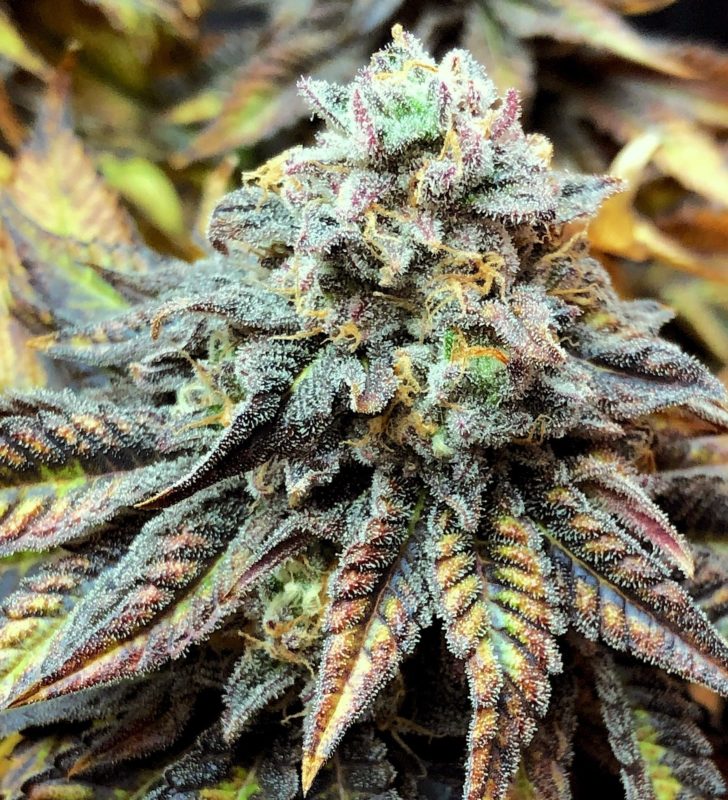
The practical takeaway is to treat the medium-specific duration ranges as a starting point and adjust based on how a specific cultivar’s trichomes and runoff EC actually behave, rather than assuming every strain clears salts or finishes ripening at the same pace.
Post-flush care and handling before harvest
Once trichomes hit your target and runoff or reservoir EC has trended down, the next window before cutting matters as much as the flush itself. Many growers give plants a short period in darkness, often 24 to 48 hours, before harvest, though the quality benefit of this step is debated and not something flushing research directly addresses.
Handle the plant gently in the final days. Avoid bruising buds or breaking trichome heads through rough handling, since trichomes hold the resin that flushing is ultimately meant to help showcase. If buds show the yellowing and fading typical of a completed flush, that is the expected outcome rather than a problem to correct.
Once cut, what happens in drying and curing has a larger measurable effect on final smoke quality than the flush itself. Our guide to drying and curing buds and the companion expert tips on drying and curing weed walk through humidity and temperature targets for this stage, which is where much of the harshness or smoothness in finished flower actually gets determined. A flush sets up cleaner raw material, but a rushed or poorly controlled dry can undo much of that benefit.
Environmental factors affecting flushing efficacy
Temperature and humidity around the root zone and canopy both influence how well a flush actually clears salts in the time you have allotted. Warmer root zone temperatures generally speed up microbial activity and nutrient release in soil and coco, which can mean salts clear faster, but excessive heat also stresses roots and can slow water uptake overall, working against the flush.
Humidity affects transpiration rate, and transpiration is what drives water, and the salts dissolved in it, up through the plant and out through the leaves. Low humidity paired with strong airflow increases transpiration and can speed up how quickly a plant draws down stored reserves and processes flushed water through its system. Very high humidity slows that process and can leave more residual salt in tissue by the end of a standard flush window.
Light intensity and photoperiod also play a role indirectly, since a plant under strong, consistent light late in flower continues more active nutrient cycling than one under stressed or inconsistent conditions. Keeping environmental conditions stable, rather than letting temperature and humidity swing widely, during the flush window makes runoff EC and trichome development more predictable and easier to track against the targets covered earlier.
Author’s perspective: a conservative, low-risk flushing protocol
Most growers would do better treating flush length as a range tied to trichomes and runoff EC rather than a fixed number of days circled on a calendar. Measure your water’s baseline EC, keep pH consistent with what you ran all flower, and check trichomes daily as harvest nears. If fan leaves yellow faster than trichomes mature, harvest early rather than chasing a flush timeline that is clearly running ahead of the plant.
The research backs a measured approach: short, monitored flushes carry less yield risk than long ones, and the evidence for dramatic quality gains from aggressive flushing is thinner than grower folklore suggests. Drying and curing afterward likely shape the final smoke more than the flush itself.
The
Seeds and resources for predictable flowering windows
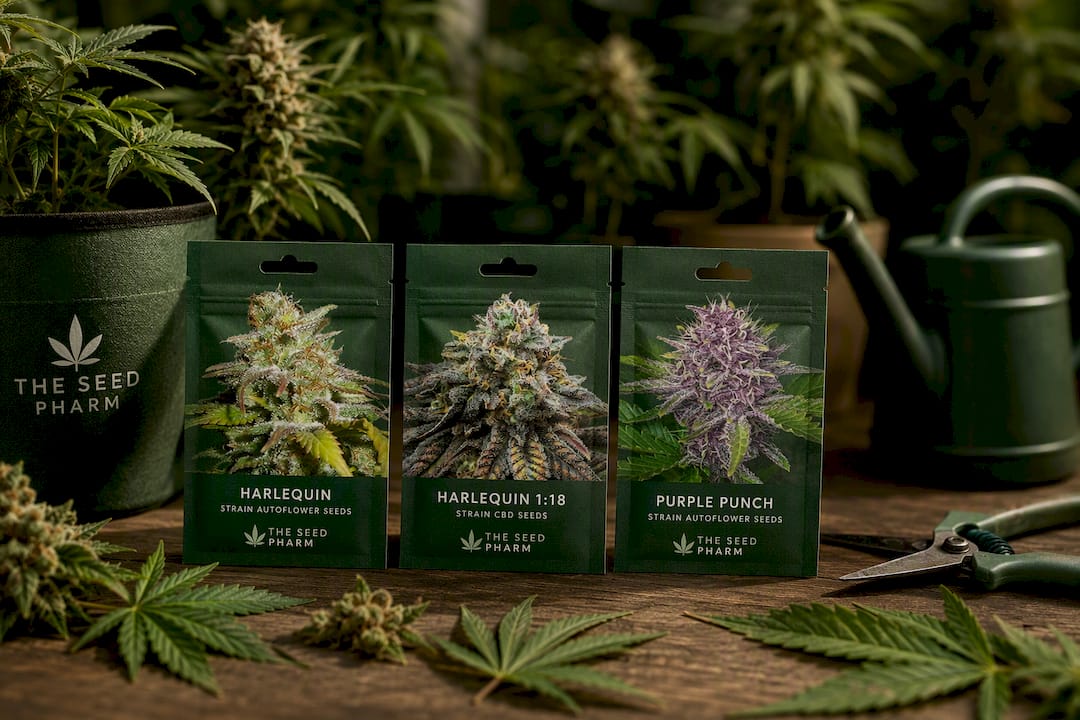
Predictable trichome timing starts with genetics that finish consistently, which is part of why we select strains for reliable flowering behaviour. Harlequin Strain Autoflower SeedsHarlequin 1:18 Strain CBD Seedsand Purple Punch Strain Autoflower Seeds are three of the genetics we carry with well-documented flowering timelines, which makes scheduling a flush easier to plan around.
Before you schedule your next flush, a couple of resources help fill in the gaps:
- Our flowering stage guide walks through how to read trichome and pistil signals across flower.
- Browse our full seed catalogue for feminized, autoflowering, CBD, and regular seeds with a germination guarantee on every order.
FAQ
How long after flushing should I harvest?
Harvest as soon as your flush window for the medium is complete and trichomes show roughly 50% milky with 10 to 30% amber, typically 7 to 14 days after starting in soil, 5 to 7 in coco, or 3 to 5 in hydro. If fan leaves yellow faster than that, harvest early rather than waiting out the full window.
Does flushing cannabis really work?
Research is mixed: a university nutrient-management study found flushing lowers leaf nitrogen but often leaves flower nitrogen largely unchanged, with inconsistent effects on cannabinoid totals. Flushing likely helps clear residual mineral salts that affect smoke harshness, but dramatic quality claims go beyond what the evidence currently supports.
Should I remove all fan leaves before harvest?
Flushing and defoliation are separate practices, and the research summarized here addresses nutrient flushing, not leaf removal. Many growers remove large, light-blocking fan leaves for airflow and drying efficiency, but stripping all foliage right before harvest is not something flush research specifically recommends.
Is leaving cannabis in the dark before harvest beneficial?
Some growers give plants 24 to 48 hours of darkness before cutting, believing it boosts resin production, though this is a separate practice from flushing itself. The evidence for this specific technique is anecdotal rather than drawn from the controlled studies covered here, so treat it as optional rather than essential.
Sources
- Flushing plants: how to do it & when – Hydrobuilder learning center
- Nutrient management of cannabis in controlled environments (USU thesis)
- Horticultural strategies to improve yield and efficiency for controlled-environment cannabis production (Clemson dissertation)
- Cultivation strategies to modify biomass partitioning and improve yield in controlled-environment production of high-cannabidiol cannabis, HortScience
Recommended