
Sep
How To Grow Marijuana Seeds
Seed Pharm’s SOG Picks: Biscotti, Maxigom, and Alpine Star
For Sea of Green, the strains worth building a canopy around are Biscotti Strain Feminized Seeds, Maxigom Strain feminized seeds and Alpine Star Strain CBD seeds, chosen for compact frames, predictable flowering windows and strong apical dominance. Clones deliver the tightest uniformity, but feminized seeds from stable, well-documented lines work fine for growers who accept slightly more variance.
TL;DR:
- Clones provide almost absolute uniformity in SOG, while feminized seeds from stable lines offer acceptable consistency with some genetic variation.
- Strains with strong apical dominance, low stretch, and short flowering times around 7 to 9 weeks are best suited for high-density SOG setups.
- Restricting fertilizer at flower start and controlling shoot number are proven techniques to increase yield per square meter in dense canopies.
- Dense packing heightens risks of bud rot, mildew, and pest spread, requiring vigilant monitoring and airflow management.
- Using small pots and starting all plants simultaneously helps maintain synchronized growth and optimize canopy uniformity.
Table of Contents
- At-a-glance shortlist for a SOG canopy
- Strain traits that matter in SOG: apical dominance, stretch and flowering time
- The horticulture under the hood: how SOG boosts yield per square metre
- SOG techniques that affect strain performance
- Deciding whether to run clones or seeds in your SOG
- Why trust these strain picks: the Seed Pharm’s proof points
- Common pest and disease issues specific to SOG cultivation
- Nutrient management tailored for high-density SOG grows
- How humidity and temperature affect different strains in a SOG tent
- Harvesting and trimming a compact SOG canopy
- When SOG is the right tool: a grower-first perspective
- Buy SOG-ready seeds from the Seed Pharm
- Sources
- FAQ
At-a-glance shortlist for a SOG canopy
Before setting up trays or clone domes, it helps to see how each strain’s traits map onto a Sea of Green layout. The numbers below are general growing parameters, not laboratory figures, and are meant as planning references rather than guarantees.
- Biscotti Strain Feminized Seeds: dense, resinous central colas with a flowering window that typically runs 8 to 9 weeks, suited to plant counts around 4 to 6 per square metre in a SOG tray.
- Maxigom Strain Feminized Seeds: a faster finisher with a compact frame, usually ready in roughly 7 to 8 weeks, allowing slightly higher density in the 5 to 7 plants per square metre range.
- Alpine Star Strain CBD Seeds: a low-stretch, CBD-forward strain that finishes in a similar window to Biscotti and holds its shape well under tight spacing.
Feminized seeds cut out the risk of hidden males wrecking a synchronized canopy, which matters more in SOG than in any other setup because every plant is meant to behave the same way. Clones go a step further: since every cutting shares identical genetics, height, branching and flowering onset line up almost exactly, which is the whole point of the technique. Growers working from seed should still expect a bit of a spread, even within a stable feminized line, and should plan vegetative time with that in mind rather than assuming instant uniformity.
Strain traits that matter in SOG: apical dominance, stretch and flowering time
Indica and sativa labels tell you almost nothing useful for SOG planning. Experienced cultivators generally recommend looking at measured growth parameters instead of loose category names, because two “indica” strains can behave completely differently under identical light and density.
Apical dominance refers to how strongly a plant’s main stem suppresses growth in its lower and side branches. A strain with strong apical dominance channels most of its energy into one or two central colas instead of a bushy, multi-branch structure, which is exactly the growth pattern SOG depends on. Weak apical dominance means fighting the plant’s natural shape with heavy pruning just to get a usable canopy.
Stretch percentage describes how much a plant grows after being flipped to flower, relative to its height at the switch.
- Photoperiod strains give you control over vegetative length, letting you flip whenever the canopy looks ready.
- Autoflowers move on their own internal clock, which means less flexibility but faster turnaround and no light-schedule management.
- Mixing the two in one tray breaks synchrony, since autoflowers cannot be held back to match a photoperiod’s veg timeline.
When reading breeder sheets, prioritize three numbers: expected final height, flowering weeks and stretch percentage. These three tell you more about SOG suitability than any strain description copy ever will.
Pro Tip: Keep a simple spreadsheet of stretch percentage and flowering weeks for every strain you trial, so future SOG runs start from data instead of guesswork.
The horticulture under the hood: how SOG boosts yield per square metre
SOG works by packing many small, quickly-flowered plants into a single dense canopy instead of growing a few large plants with long veg times. The goal is a short vegetative stage, a synchronized flip and a flat, even canopy top where every cola gets roughly the same light.
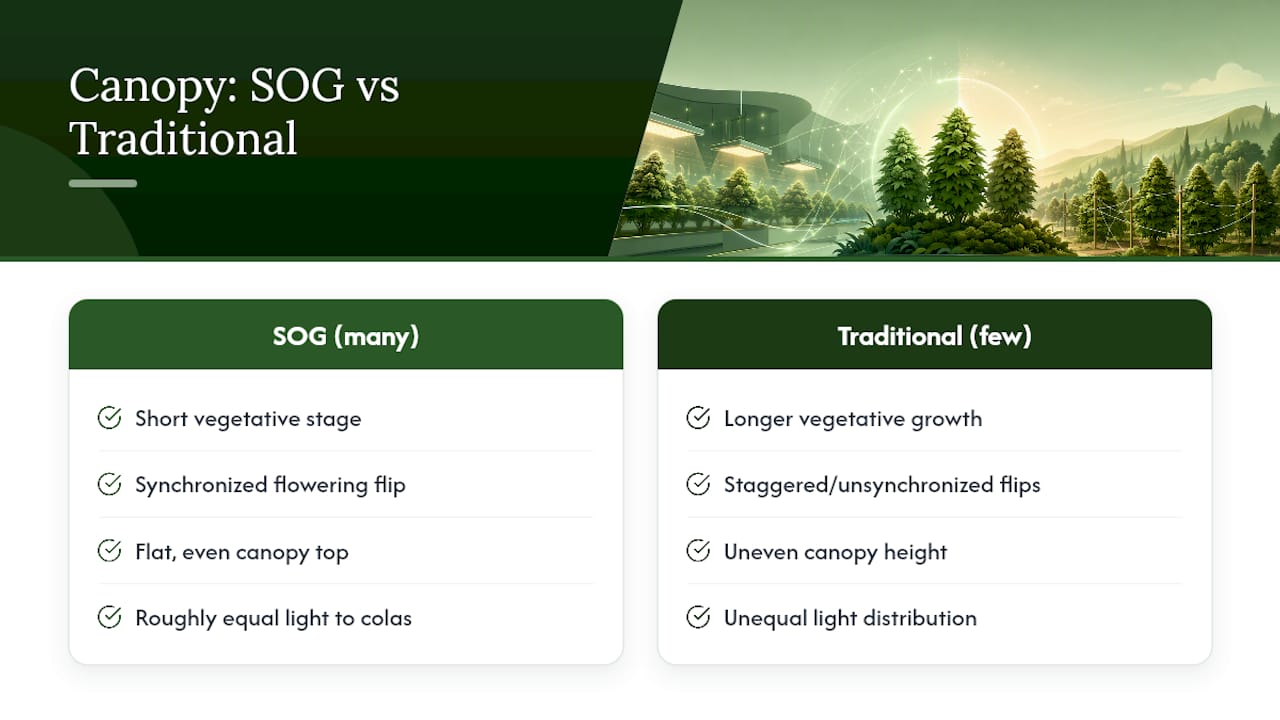
That density only pays off when genetics cooperate. Uniform, low-stretch, apically dominant strains keep the canopy flat, which means fewer shaded lower branches producing airy, low-value popcorn buds. A grower’s guide to the Sea of Green method points out that clones are the pragmatic standard here precisely because identical genetics remove the variance that would otherwise force growers to thin out slower or taller plants mid-run.
Environment does the rest of the work. Controlled trials on cannabis grown in confined environments have shown that adjusting shoot number and restricting fertilizer at the start of flower can shift a plant’s biomass toward flower production and away from vegetative structure, improving yield per unit area. In a SOG context, where every square metre is already carrying more plants than a traditional canopy, that shift in biomass partitioning compounds across dozens of plants rather than just one or two, which is why genetics and technique need to be tuned together rather than treated as separate problems.
SOG techniques that affect strain performance
Getting a strain’s genetics to actually show up in the final yield depends on a handful of training and nutrition decisions made early in the run.
- Lollipopping timing: strip lower foliage and small popcorn sites once the plant is roughly two to three weeks into flower, focusing energy on the top colas and cutting down on humidity pockets that invite rot.
- Shoot-number manipulation: pinching early growth to control how many main shoots a plant develops has been shown in controlled trials to reduce shoot length and improve the ratio of usable flower to trim, a lever that matters directly for labour costs at harvest time.
- Fertilizer restriction: cutting back nitrogen at the very start of flower, based on the same horticultural research, can reduce plant area while increasing flower yield per square metre, an effect worth testing on a small batch before applying across a full tray.
- Spacing and light intensity: keep canopy height low and even, and match PPFD to a dense, low-stretch canopy rather than the higher intensities used for widely spaced, large-format plants.
- Pot size and clone handling: small pots (roughly 1 to 3 gallons) restrict root zone size to match the compact above-ground frame, and starting all clones or seedlings on the same day keeps root development, and therefore canopy timing, in sync.
Restricting fertilizer at flower-start and controlling shoot number are two of the most reliable levers for lifting yield per square metre in dense canopies, according to controlled cannabis production research, which found both techniques shifted biomass toward inflorescence over vegetative growth.
Deciding whether to run clones or seeds in your SOG
Clones win on uniformity because every cutting carries the same genetics, which means matched stretch, matched finish time and a harvest window where every plant is actually ready on the same day. That single advantage is why practitioner guides on the Sea of Green method treat clones as the default choice for serious SOG runs.
Seeds still make sense when you want to test new genetics, avoid maintaining a mother plant, or simply don’t have clone access. Stable, well-documented feminized lines with clear breeder data on stretch and flowering time narrow the variance considerably, even without genetic identity.
- Run a small phenohunt batch first to identify the most uniform individuals before committing a full tray to one line.
- Start more seedlings than you need in slightly larger trays, so you can cull outliers before the flip.
- Hold every plant to the same veg length and light schedule so any remaining genetic variance shows up early, not at harvest.
Pro Tip: If you’re seed-only, buy double what your final tray needs and cull the slowest, tallest, or bushiest quarter before flipping to flower.
Why trust these strain picks: the Seed Pharm’s proof points
These recommendations come from The Seed Pharm’s own catalogue, which carries more than 200 strains across feminized, autoflowering, regular and CBD lines.
Orders ship discreetly with tracking across Canada, the US and Australia, and orders above a set threshold include free seeds, which helps offset the cost of running the larger seed counts a dense SOG tray demands.
For readers planning a full run, a few companion guides fill in the gaps this article doesn’t cover in depth: the cannabis flowering stage guide for timing a synchronized flip, the nutrients guide for building a feed schedule around restricted early-flower fertilizer, and the clones versus seeds breakdown for growers still weighing which starting material fits their setup.
Common pest and disease issues specific to SOG cultivation
Dense planting creates its own risk profile. Airflow gets harder to manage as stem count rises, and humidity tends to pool low in the canopy where lollipopping hasn’t cleared foliage, which is one reason that practice matters as much for disease prevention as for yield.
Botrytis, commonly called bud rot, is the biggest threat in a tight SOG canopy because dense, touching colas trap moisture right where flowers are forming. Powdery mildew follows a similar pattern, favouring the still, humid air that collects between crowded plants. Spider mites and fungus gnats spread faster in SOG than in widely spaced grows simply because there’s less distance between hosts, so an infestation on one plant reaches its neighbours within days rather than weeks.
Strain susceptibility varies mostly with bud density and leaf structure rather than with indica or sativa lineage. Tighter, more resinous colas like Biscotti’s tend to hold moisture longer after watering or misting, which raises rot risk if airflow isn’t dialed in. Looser, airier structures dry faster but can still succumb to mildew if humidity runs high for extended stretches.
Daily visual checks matter more in SOG than in any other setup, because a problem that starts on one plant in a 40-plant tray can move through the whole canopy before it’s obvious from a glance. Removing any lower growth that lollipopping missed, and keeping a small oscillating fan pointed across the canopy rather than straight up into it, addresses most of the airflow-related risk without extra equipment.
Nutrient management tailored for high-density SOG grows
High-density trays draw down nutrients faster than widely spaced plants because root zones are smaller and total plant count per square metre is higher. That means checking runoff and feed strength more often than a standard grow schedule would suggest, particularly during the stretch into early flower when demand shifts quickly.
Nutrient optimisation research on soilless cannabis in the flowering stage found that nitrogen and phosphorus levels within specific ranges affect inflorescence yield meaningfully, with one study identifying nitrogen near 194 milligrams per litre and phosphorus near 59 milligrams per litre as favourable starting points for the cultivar tested in deep-water culture, while potassium showed less effect across the ranges tried. Those figures come from one soilless trial and one cultivar, so treat them as a starting reference rather than a fixed target, and adjust based on your own runoff readings and plant response.
Combined with the fertilizer restriction findings from controlled shoot-number trials, a workable approach is to feed at a fuller strength through vegetative growth, then dial nitrogen back at the very start of flower to encourage the plant to commit resources to bud sites rather than continued stem and leaf growth. Small pots used in SOG setups make this easier to manage since the root zone can’t buffer nutrient swings the way a larger container would, so changes in feed strength show up in plant response within days rather than weeks.
How humidity and temperature affect different strains in a SOG tent
Dense canopies hold humidity closer to the plants than open, widely spaced setups, which means the same tent-wide humidity reading can mean very different things depending on how much foliage is packed into that square metre. Strains with tighter, denser bud structure, like Biscotti, need slightly lower relative humidity through flower than looser-structured strains to avoid trapping moisture inside developing colas.

Temperature swings hit SOG canopies harder too, since heat radiating off a dense mass of lights and foliage has fewer gaps to dissipate through. Keeping daytime temperatures in a moderate range and avoiding sharp night drops helps prevent the condensation that triggers mould growth in a tightly packed tray.
Low-stretch strains such as Alpine Star tend to tolerate slightly higher planting density without airflow problems, since their compact frame leaves more open space between colas even at close spacing. Faster finishers like Maxigom spend less total time in the humidity-sensitive stretch phase, which can reduce the cumulative risk window compared with slower strains held at the same density.

Running a small circulating fan at canopy height, rather than relying on the tent’s main exhaust alone, evens out the microclimates that form between closely packed plants and is one of the simplest fixes for strain-specific humidity sensitivity in a dense tray.
Harvesting and trimming a compact SOG canopy
Compact SOG strains tend to finish close together when genetics and veg timing are matched, which means harvest day involves cutting far more individual plants at once than a traditional grow with fewer, larger specimens. Staggering the cut by a day or two across sections of the tray, rather than pulling everything at once, keeps drying and trimming manageable.
Because SOG plants are small and carry most of their weight in one or two central colas, whole-plant hang-drying works well and is often faster than hanging individual branches. Trimming is lighter too: with lollipopping already having removed most of the lower foliage weeks earlier, there’s less fan leaf and popcorn bud to deal with at harvest, which is part of why the Clemson research on shoot-number manipulation frames improved inflorescence-to-trim ratio as a direct labour saving.
Dense, resinous colas like those on Biscotti benefit from a slightly slower dry, since moisture trapped deep in a tight bud takes longer to escape than in looser structures. Rushing the dry on a dense cola risks mould forming from the inside out, even after the outer surface feels ready.
When SOG is the right tool: a grower-first perspective
SOG earns its reputation when space is limited and you want maximum grams per square metre from short, predictable plants, but it demands more hands-on labour than almost any other method: frequent lollipopping, tight spacing to manage, and a harvest day that hits dozens of plants at once instead of a handful.
Growers who prefer fewer, larger plants and less routine handling are usually better served by a traditional canopy. And with average THC concentrations in tested US samples typically running above 10% across regions over the past decade, and a systematic review flagging limited, low-certainty evidence linking higher potency to some adverse outcomes, it’s worth pacing consumption regardless of which method produced the harvest.
— The.
Buy SOG-ready seeds from the Seed Pharm

Biscotti Strain Feminized Seeds and Maxigom Strain Feminized Seeds both fit a compact, high-density tray without the guesswork of unverified genetics, and Alpine Star Strain CBD Seeds gives CBD-focused growers a low-stretch option built for the same layout. Every batch at The Seed Pharm goes through inspection before it ships, backed by a 90% germination guarantee, so a full SOG tray isn’t riding on unverified seed stock. Some orders include free seeds, and shipping is discreet and tracked. Start with the Biscotti Strain Feminized Seeds product page to check current availability for your next tray.
Sources
- A 10-year trend in cannabis potency (2013–2022) in different geographical regions of the United States of America
- High-potency cannabis use and health: a systematic review of observational and experimental studies
- Horticultural strategies to improve yield and efficiency for controlled-environment cannabis production
- A guide to the Sea of Green (SOG) method
FAQ
What strain produces the strongest effects?
There is no single strain that reliably produces the strongest effects for everyone, since response depends on tolerance, dose and the individual. Potency data shows average THC levels in tested US samples typically running above 10% across regions, so checking lab-reported THC percentage on any specific batch is more reliable than relying on a strain’s reputation alone.
How many plants fit per square metre in a SOG setup?
Plant density depends on the strain’s compactness, but growers commonly run somewhere in the range of four to seven plants per square metre for compact, low-stretch varieties. Faster-finishing, more compact strains generally tolerate the higher end of that range better than tall or bushy ones.
Should I use autoflowers or photoperiod strains for SOG?
Photoperiod strains give more control since you decide when to flip to flower, which helps synchronize a mixed tray. Autoflowers finish on their own fixed schedule and work well for speed, but they shouldn’t be mixed with photoperiods in the same tray since the two can’t be held to the same timeline.
Are clones better than seeds for a uniform SOG canopy?
Clones generally produce a more uniform canopy because every cutting shares identical genetics, matching stretch and flowering time exactly. Feminized seeds from stable, well-documented lines are a reasonable alternative when clones aren’t available, though some variation between plants should be expected.
How long does a typical SOG strain take to flower?
Flowering time varies by strain, but many compact varieties suited to SOG finish in roughly seven to nine weeks. Checking a strain’s specific breeder data for expected flowering weeks is more reliable than assuming a fixed timeline across different genetics.
Recommended