Sep
How To Grow Marijuana Seeds
Beginners, Measure First: Plant Cannabis Seeds 6–13 mm Deep
Plant cannabis seeds 3 to 12 mm deep (about 1/8 to 1/2 inch), with 6 to 13 mm as the safest starter target for most home growers. That depth changes with seed size, medium texture, and moisture, so a fine coco mix calls for the shallow end and a dry, coarse soil can handle a touch more. Do it now: prepare a loose, pre-moistened medium, set the seed at that range, cover lightly, and keep it evenly damp.
TL;DR:
- Plant cannabis seeds in 6 to 13 mm of medium, adjusting shallower for fine seeds and outdoor sandy soils, or slightly deeper for coarse, fast-draining conditions.
- Use a pre-moistened, loose medium and measure planting depth carefully before watering to maintain consistency and avoid planting too deep or shallow.
- Seed size largely determines depth; small seeds under 4 mm often require surface sowing or minimal covering, while larger seeds need a two to three times seed width coverage.
- Proper depth ensures sufficient seed energy and oxygen availability, reducing the risk of failure or rot, especially in dense or waterlogged soils.
- Most germination failures are due to incorrect planting depth or seed quality, emphasizing the importance of good technique and high-quality, well-inspected seeds.
Table of Contents
- Cannabis planting depth: recommended ranges and when to use them
- Why cannabis planting depth matters more than most beginners think
- How to measure and plant cannabis seeds at the right depth
- Adjusting depth for soil, coco, rockwool, and outdoor beds
- Troubleshooting cannabis seeds planted too shallow or too deep
- From planting to sprout: timeline and early seedling care
- What I’ve learned about cannabis planting depth
- Get the right seeds before you worry about the right depth
- Sources
- FAQ
Cannabis planting depth: recommended ranges and when to use them
The 6 to 13 mm range works for most cannabis seeds in most home setups, and it lines up with what practical cultivation guides commonly recommend for planting cannabis seeds indoors and outdoors. Treat 1 cm (10 mm) as your mental default. It’s easy to eyeball, it’s roughly two to three times the width of an average cannabis seed, and it gives the emerging shoot a short, manageable trip to the surface without leaving the seed exposed to drying air.
That “two to three times seed width” rule isn’t a cannabis-specific invention. It’s a long-standing principle from vegetable and field-crop seeding, and University of Maryland Extension applies it the same way across dozens of species. Cannabis seeds sit in the small-to-medium range, comparable to a lettuce or pepper seed in size, which is exactly why the 6 to 13 mm window holds up so consistently.
Here’s how to pick a number inside that range instead of just guessing:
- Shallow end (3 to 5 mm): use this for very fine seed batches, loose soilless mixes, or rockwool cubes where moisture is already abundant and oxygen exchange is high.
- Mid-range (6 to 12 mm): the default for most feminized, autoflower, and regular seeds going into standard potting soil or coco coir.
- Deeper allowance (up to roughly 13 to 15 mm): reserved for coarse, sandy, or fast-drying outdoor soil, where a slightly deeper placement protects the seed from surface drying and temperature swings.
Pro Tip: If you’re unsure which end of the range to use, go shallower. A seed planted a few millimetres too shallow can be gently top-dressed with more medium after it sprouts; one planted too deep may never make it to the surface at all.
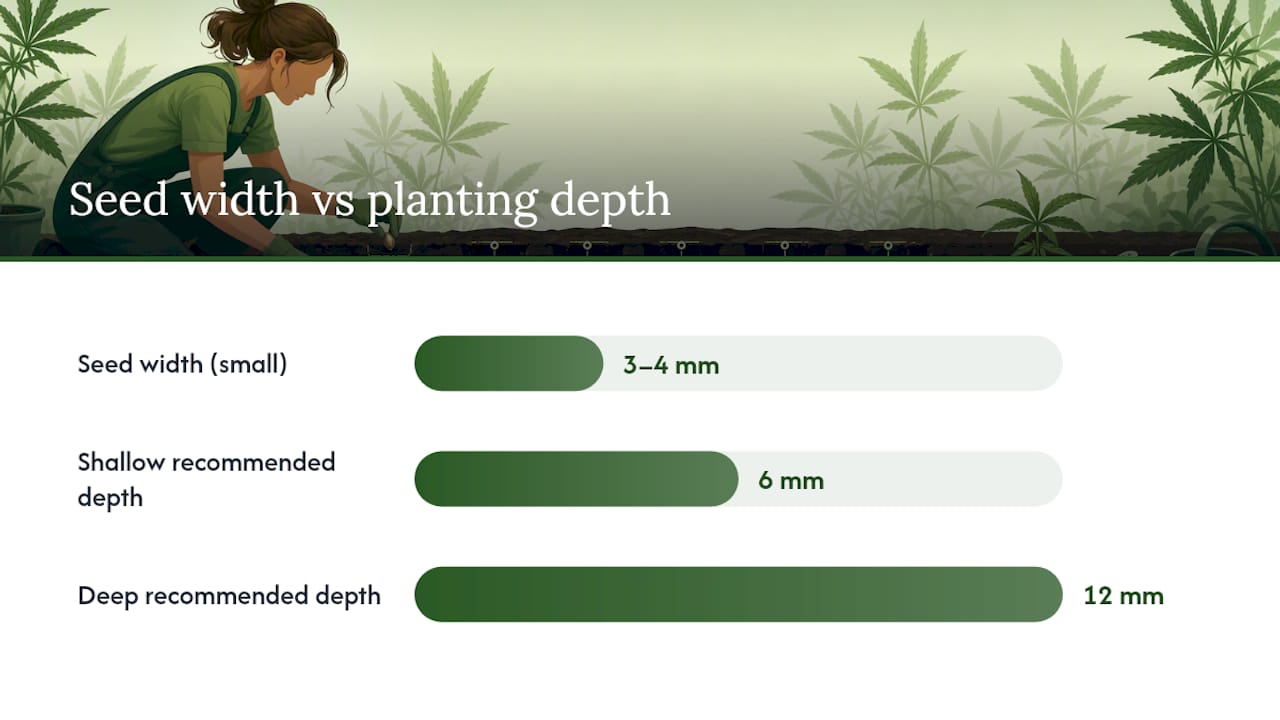
One statistic worth sitting with: seed size itself dictates most of this variation. A seed that measures roughly 3 to 4 mm across should sit under 6 to 12 mm of medium, which is the two to three times multiplier in action. Growers who try to standardize on one exact depth for every strain and every medium are working against basic seed physics, not with it.
Very small or unusually fine seed types are the exception to almost everything above. Nebraska Extension’s planting guidance notes that fine seeds often do better surface sown or under a bare dusting of medium, followed by frequent misting rather than a deep, dry burial. This matters less for standard cannabis seed stock, which tends to be uniform in size, but it’s a useful reminder that “deeper is safer” is a myth across the board.
Why cannabis planting depth matters more than most beginners think
A cannabis seed carries a fixed energy budget. Everything the seed needs to push a hypocotyl (the stem-like structure that arches up before the first leaves unfurl) through the medium and into daylight comes from the reserves packed inside that seed coat. Plant too deep and you ask a small energy store to do a longer, harder job. Some seeds make it. A meaningful share simply run out of fuel before they reach the surface, and you never see them again.
Oxygen availability is the second half of the equation, and it’s the one beginners overlook most. Compact, waterlogged soil has fewer air pockets than loose, airy medium, which slows the oxygen diffusion a germinating seed needs to fuel that energy conversion. This is why pressing soil down hard over a seed, even at the correct measured depth, can delay or kill germination just as effectively as planting too deep in the first place. Cornell’s Certified Crop Advisor resources make the same point for field crops: a loose covering preserves the air-filled pore space that compaction destroys, even when the depth on paper looks correct.
The most useful mental model for growers is that seeds need moisture contact, oxygen in pore spaces, and a short travel path for the emerging shoot. Roots develop after emergence, not before, so planting deeper to “give the roots room” is exactly backwards.
Seed quality complicates the picture further. A 2022 peer-reviewed hemp study found that variety and seed pre-treatment materially affected germination rate and early seedling vigour, independent of planting depth. In plain terms: a seed batch treats depth as one variable among several, not the only one. If you nail the depth and moisture and still see poor germination, genetics and seed handling deserve a look before you blame your technique.
| Factor | Effect on ideal depth | Practical adjustment |
|---|---|---|
| Seed size | Smaller seeds need shallower cover | Surface sow or 3 to 5 mm for fine seed |
| Medium density | Compact soil slows oxygen diffusion | Use loose, airy mix; avoid tamping |
| Moisture level | Wet medium needs less depth | Shallow end in already-moist soil |
| Ambient temperature | Cool soil slows emergence | Slightly shallower depth speeds warming |
| Soil texture | Sandy soil dries fast | Plant a touch deeper outdoors in sand |
This table is really a summary of one idea: depth is never a fixed number, it’s a response to conditions. Once you understand why, adjusting on the fly for a new grow medium stops being a guessing game.
How to measure and plant cannabis seeds at the right depth
Getting the depth right on paper means nothing if your hands don’t execute it consistently. Here’s the sequence that removes the guesswork.
-
Pre-moisten your starter medium. Whether it’s a seedling mix, coco coir, or a rockwool cube, dampen it before you plant, not after. A pre-moistened medium holds its shape around the seed and won’t collapse or shift once you water it, which keeps your measured depth intact.
-
Choose a small starter container. A 4 to 6 cm pot or a rockwool cube is plenty for the first stage. You’ll transplant later, so there’s no benefit to starting big, and a small container is easier to keep evenly moist.
-
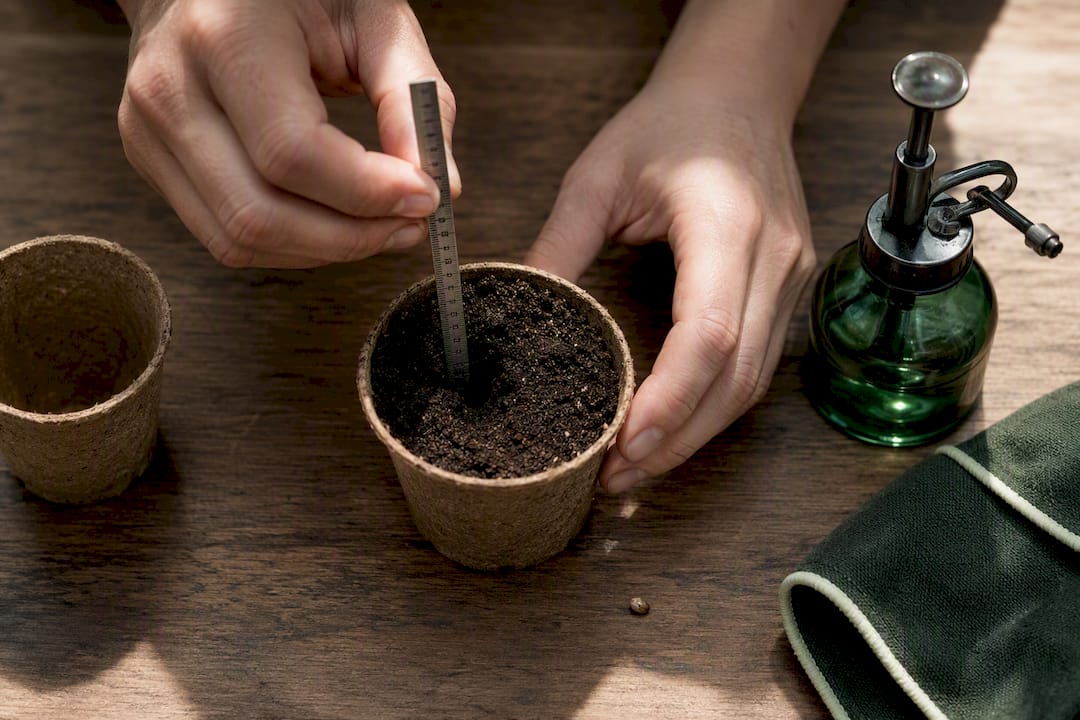
Measure the hole before you do anything else. Use a small ruler, a marked toothpick, or a pen with a line drawn at 10 mm. University of Maryland’s sowing guidance specifically recommends measuring the hole before watering, since watering afterward can wash a shallow seed deeper or expose one that was placed correctly.
-
Make the hole with something narrow. A toothpick, a pencil tip, or a chopstick works better than a finger, which tends to compact the sides of the hole and create a denser pocket than the surrounding medium.
-
Place the seed taproot down if you can see one. If your seed has already cracked and shows a visible taproot, orient it downward. If it hasn’t cracked yet, lay it on its side; gravity and the seed’s own growth response will sort out the rest.
-
Cover lightly, without pressing down. Sprinkle loose medium over the seed until it reaches your target depth, then stop. Do not pat, press, or tamp the surface. A firm hand here is the single most common way beginners accidentally recreate the “planted too deep” problem even at a correct measured depth.
-
Water with a mister, not a stream. A fine mist settles the medium gently around the seed without displacing it. Pouring water from a cup or watering can is often enough force to shift a shallow seed several millimetres deeper than intended.
Pro Tip: Measure before you water, every time. Once medium is wet, it compacts and shifts, and a hole you dug to 8 mm can easily become 12 mm by the time you’ve finished misting. Get the depth locked in on dry or lightly damp medium first.
If you want a deeper walkthrough of germination methods beyond planting depth alone, including paper towel and direct-to-medium comparisons, Theseedpharm’s germination guide covers the full process step by step.
Adjusting depth for soil, coco, rockwool, and outdoor beds
The 6 to 13 mm starter range is a baseline, not a rule that ignores what you’re actually planting into. Different media hold moisture and oxygen differently, and your depth should shift accordingly.
- Standard potting soil: stick to the middle of the range, around 8 to 10 mm. Potting soil is airy enough to support that depth without smothering the seed, but dense enough to hold moisture for a few days between waterings.
- Coco coir: lean toward the shallow end, 5 to 8 mm. Coco drains fast and dries from the top down, so a shallow planting keeps the seed in the moister zone longer without drowning it.
- Rockwool cubes: plant at 6 to 10 mm in the pre-cut hole, and resist the urge to pack extra rockwool fibre over the top. Rockwool holds water aggressively, and over-covering traps excess moisture right where the seed needs oxygen most.
- Starter plugs (peat or coco-based): most come with a pre-formed hole around 10 to 12 mm deep. Use it as designed rather than digging deeper, since these plugs are engineered around that specific depth.
- Outdoor sandy or fast-draining soil: push toward 12 to 15 mm. Sandy soil dries out fast in direct sun, and a slightly deeper placement buys the seed a buffer against surface heat and moisture loss. Michigan State University Extension’s planting depth guidance makes this same case for field crops in sandy versus clay soils, and the logic transfers directly.
- Outdoor clay-heavy or waterlogged soil: stay shallow, closer to 6 mm, since dense clay already restricts oxygen and a deeper seed in that medium struggles even more.
One thing to clear up before it becomes a costly mistake: container size has nothing to do with seed depth. A 20-litre outdoor pot doesn’t call for a deeper seed than a 500 ml starter cup. Seed depth is set by seed size and medium texture, full stop, not by how much soil sits below it. If you’re planning to start seeds directly in a large container or outdoor bed, it’s worth reading why starting in a small container first usually beats direct sowing into a big pot from day one, since it gives you far tighter control over that critical first depth measurement.
Timing matters outdoors too. If nighttime lows are still dipping below what your seedling can tolerate, a slightly deeper placement offers modest thermal buffering, but it’s not a substitute for simply waiting a week or two until soil temperatures stabilize.
Troubleshooting cannabis seeds planted too shallow or too deep
Most germination failures trace back to one of two mistakes, and both are fixable once you know what you’re looking at.
Planted too shallow — what you’ll see:
- The seed dries out on the surface before the taproot can anchor, especially in warm or breezy rooms.
- “Helmet head,” where the seed shell stays clamped onto the first leaves as they try to unfurl, happens more often with shallow, dry plantings because the shell never got enough sustained moisture to soften and release.
- Fix: mist more frequently, and if the seed is visible on the surface, gently push it down with a toothpick and add a thin layer of loose medium over the top.
Planted too deep — what you’ll see:
- No emergence after 10 to 14 days despite consistent moisture and warmth. The seed either ran out of energy reserves before reaching the surface, or it’s sitting in an oxygen-poor pocket and has begun to rot instead of sprout.
- A sour, damp smell from the planting site is a strong signal of rot rather than dormancy.
- Fix: if you’re within the first week and the medium isn’t compacted, a gentle, shallow excavation to check on the seed is reasonable. Past 14 days with no sign of life, it’s usually more efficient to re-sow at the correct depth than to keep waiting.
Damping-off is a separate but related risk, and it strikes seedlings that have emerged, not seeds still underground. It shows up as a thin, water-soaked, collapsing stem right at the soil line, usually within days of sprouting. Overly wet, poorly ventilated conditions are the main driver. Prevent it by avoiding fertilizer in the planting hole entirely; MDPI Agronomy’s fertility research points out that strong fertilizer at the seedling stage can do more harm than good, since young roots aren’t equipped to handle concentrated nutrients yet. Keep gentle airflow moving across your seedling trays, and let the surface medium dry slightly between mistings rather than keeping it saturated around the clock.
If you’ve had repeated failures at what you’re confident is the correct depth, it’s worth asking whether the seed batch itself is the problem. Not every failed germination is a depth or technique issue. For background on how seed viability and storage affect germination odds independent of planting technique, it’s a factor worth ruling out before you assume you did something wrong.
From planting to sprout: timeline and early seedling care
Once you’ve planted at the correct depth in a warm, evenly moist medium, emergence typically happens in 2 to 7 days. That window holds up consistently across grower reports and cultivation resources when depth and moisture are both correct, so it’s a reasonable benchmark to plan around rather than an exact promise.
- Days 1 to 2: the seed absorbs moisture and begins to swell. Nothing visible happens above the surface yet, and that’s normal.
- Days 2 to 4: the taproot emerges from the seed shell and anchors downward, while the hypocotyl begins its push upward through the medium.
- Days 4 to 7: the seedling breaks the surface, typically still wearing its seed shell like a cap, which falls away naturally within a day or two.
- Past day 7 with no emergence: check root zone temperature first. Cannabis seeds germinate most reliably between roughly 22 and 27°C. Cooler soil slows every stage of this timeline substantially.
Light should stay gentle and indirect for the first several days. Direct, intense light on a seedling that’s just cracked the surface can stress it before its root system is established enough to support real growth.
Transplant out of the small starter container once you see two to three sets of true leaves, usually somewhere around 10 to 14 days after emergence. That’s also roughly when it’s safe to introduce a very dilute starter feed, since the low-nutrient approach recommended for germination no longer applies once the seedling has real root mass. For a fuller picture of what the plant needs as it moves past this stage, Theseedpharm’s guide to the vegetative stage covers the environmental shifts that come next.
What I’ve learned about cannabis planting depth
Two rules of thumb cover almost every situation a beginner will run into. First: when in doubt, go shallow, not deep. A shallow miss is recoverable with a mist bottle and a little patience. A deep miss often isn’t recoverable at all. Second: measure the hole, don’t eyeball it. “About a centimetre” in your head and 10 mm on a ruler are not the same thing once you’ve planted forty seeds over a few seasons, and the difference shows up in your germination rate whether you notice it or not.
The gap between good planting technique and good genetics gets confused constantly. Depth, moisture, and medium texture only get you so far if the seed itself wasn’t viable to begin with, which is exactly why Theseedpharm inspects seed batches before they ship and backs orders with a 90% germination guarantee. Precise depth matters. It matters more when the seed underneath it was worth planting in the first place.
I’ll be honest about the limits here too: no depth chart replaces attentive daily observation of your own setup. Humidity, container material, and even the brand of starter mix you use all shift these numbers slightly. Treat every range in this guide as a strong starting point, then adjust based on what your own seedlings tell you over the first few grows.
— The
Get the right seeds before you worry about the right depth
Planting depth only pays off if the seed underneath it was worth planting. Theseedpharm’s approach starts earlier than most seed banks: every batch goes through quality inspection before it’s listed, backed by a 90% germination guarantee, so the depth and technique covered above actually have something reliable to work with.
Beginners looking for a forgiving, well-documented option often start with CBD-dominant genetics, since they tend to grow predictably and forgive small technique mistakes better than some high-THC lines. The Harlequin 1:18 Strain CBD seeds offer stable, CBD-rich genetics that suit a first-time grower’s learning curve. For something closer to balanced, the Cheese 1:1 Strain CBD Seeds deliver a 1:1 CBD to THC ratio that’s easier to predict from seed to harvest. And if CBD content is your main priority, the Strawberry 1:15 Strain CBD Seeds push CBD concentration higher still.
Some orders include additional free seeds and feature discreet, tracked shipping to various regions. Browse the full seed catalogue to compare feminized, autoflower, CBD, and regular options, and start your next grow with a batch built to germinate.
Sources
The depth ranges and technique advice in this guide draw on a mix of university extension research and practical grower resources. University of Maryland Extension’s sowing guidance covers the core two to three times seed width rule and watering technique. Michigan State University Extension’s planting depth publication explains soil texture adjustments for sandy versus clay conditions. The 2022 peer-reviewed hemp germination study documents how variety and seed treatment affect outcomes independent of depth, and Nebraska Extension’s planting guidance details handling for fine or small seed types.
- Sowing vegetable seeds outdoors | University of Maryland Extension
- Agronomy / HortTechnology 2022 hemp germination study
- How to Plant Cannabis Indoors & Outdoors | BudTrainer
- Nebraska Extension — seeding and planting guidance
FAQ
Do bigger pots mean bigger buds?
Pot size affects root volume and, indirectly, plant size and yield potential, but it has no bearing on seed planting depth. A large final container doesn’t call for burying the seed any deeper than a small one; depth is set by seed size and medium texture, not pot capacity.
How deep is too deep for a cannabis seed?
Anything meaningfully beyond 13 to 15 mm risks the seed running out of energy reserves before reaching the surface. If you’ve planted deeper than that and see no emergence after 10 to 14 days in warm, moist conditions, treat it as a likely failure and consider re-sowing at a shallower depth.
How deep are the roots of a cannabis plant?
Root depth has nothing to do with planting depth, since roots develop downward from the seed after germination rather than starting at whatever depth the seed was placed. In containers, root systems typically fill the available pot volume; in open ground, taproots can extend well over a metre in mature, unrestricted plants.
What fertilizer makes buds bigger?
Bud size during flowering responds mainly to phosphorus and potassium-heavy nutrient formulas, but that’s a much later-stage concern than planting depth. Fertilizer has no place in the planting hole itself, since strong nutrients can harm a germinating seed before it’s even established roots.
What’s the safest cannabis seedling depth for beginners?
For most home growers, 6 to 13 mm is the safest starting range, with 10 mm as a solid default. Adjust shallower for fine seeds or airy soilless mixes, and slightly deeper only for coarse, fast-draining outdoor soil.
Recommended